

In the middle of the 19th century, when the Swiss valleys still worked by candlelight and precision was measured by touch rather than by instrument, there was a small atelier in La Chaux-de-Fonds bearing a name already whispered with respect — Courvoisier Frères.
The brothers who ran it were men of patient ambition. They sought not grandeur but balance, believing a watch should embody proportion and silence rather than ornament and noise. In their hands, brass and gold were shaped not into displays of wealth, but into architectures of harmony — discreet, exact, and alive.
In 1842, they accepted a commission that seemed almost a provocation. King Frederick Wilhelm IV of Prussia, a man equally enamoured of art and mechanics, wished for a watch of impossible refinement — as thin as human skill could allow, yet unyielding in precision.
The work required more invention than assembly. Springs were shaved to their limits, plates reimagined, screws lightened to the edge of invisibility. Each night in their workshop, the sound of filing and measuring blended with the wind from the Jura hills — the rhythm of human patience facing the limits of matter.
When it was completed, the result astonished. Courvoisier had created what was then the world’s thinnest watch — a wafer of gold and steel that seemed to contain more spirit than substance. It did not dazzle; it breathed. The Prussian court regarded it as a marvel of both intellect and grace, proof that simplicity, when perfectly drawn, could surpass ornament.
The original piece disappeared long ago, its whereabouts unknown — lost perhaps to time itself. Yet traces of its idea endure.
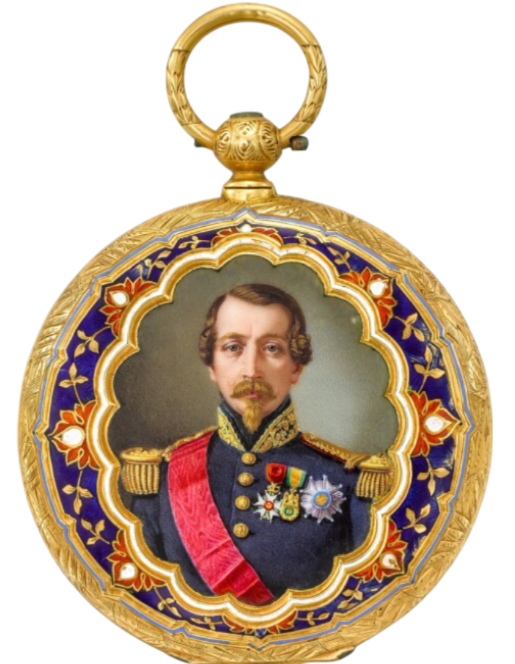
Among the few survivors of that age stands a Courvoisier regulator from 1849 — a watch that carries the same design language, the same pursuit of restrained precision. It is, most likely, a later edition born from the same philosophy, a tangible continuation of that 1842 experiment in elegance. To look upon it is to glimpse the afterimage of a vanished ideal.
What Courvoisier achieved was not a record of thinness, but a declaration of principle: that elegance is restraint, and that perfection exists on the edge of disappearance. In an age when others adorned time, Courvoisier refined it — carving away every excess until only beauty remained.
The watch may be lost, but its silence endures — a reminder that sometimes the finest creations are those that almost vanish, leaving behind only the trace of their perfection.
Because in horology, as in art, the finest line is often the one that nearly disappears.